6 juin 1944 - Un planeur CN45 se pose à Montivilliers
Le 6 juin 1944, c’est le débarquement en Normandie. Les troupes aéroportées Britanniques se chargent du flanc Est entre Ouistreham et Caen afin d’empêcher une contre-attaque qui peut faire échouer la plus grande opération militaire de tous les temps.
C’est dans la nuit du 5 au 6 juin qu’un planeur égaré arriva, ici à Montivilliers.
On 6 June 1944, the Normandy landings took place. British airborne troops took charge of the eastern flank between Ouistreham and Caen to prevent a counter-attack that could derail the biggest military operation of all time.
It was on the night of 5 to 6 June that a stray glider arrived here in Montivilliers.
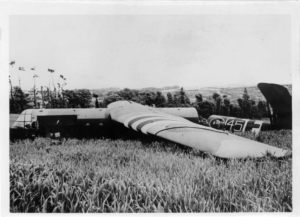
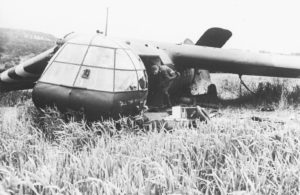
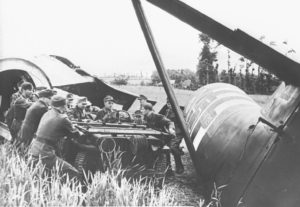
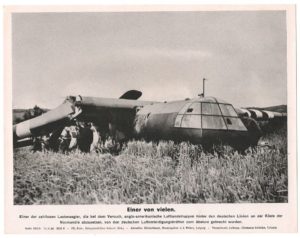
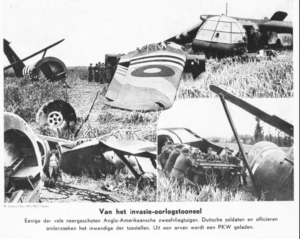
Photos réalisées par l'armée allemande
La 6th Airborne Division, est constituée de parachutistes et de troupes aérotransportées acheminées par planeurs tractés par des bombardiers.
Les 3 couloirs aériens empruntés par cette division passent à proximité du Havre, pour ne pas gêner l’armada principale qui vise les secteurs des débarquements navals.
Les Pilotes du planeur CN45 doivent amener leur équipage sur la zone d’atterrissage de Ranville, proche du canal de l’Orne près de Caen. Il est constitué d’une jeep munie d’une radio pour une équipe d’observateurs de 5 hommes qui ont pour mission de guider les tirs d’artillerie pour aider les parachutistes.
C’est ainsi que ce planeur et son avion tracteur sont touchés par les canons anti-aériens près des côtes havraises. Le Sergent POTTS, second pilote du CN 45 raconta : « Le planeur est d’abord touché vers la queue, puis une seconde fois à travers le cockpit.
Une munition enflamme la toile du cockpit à gauche. Le temps de vol est trop long et nous avons certainement dépassé notre objectif. La communication avec l’avion tracteur était très mauvaise quand soudain nous sommes retombés sur une ceinture de canons anti-aériens puis nous découvrons que nous sommes en vol libre. »
Que s’est-il passé, un câble a-il-été coupé, l’avion a-t-il été touché ?
Le planeur est de nouveau frappé et les flammes reprennent. Il faut vite poser le planeur qui n’a pas d’autonomie de vol sans être tracté. Le Pilote Bill JONES aperçoit un champ où se poser. « Le saint patron des Pilotes de Planeurs devait faire des heures supplémentaires ce jour-là » dirent les pilotes plus tard car le planeur se pose après avoir heurté des arbres sans qu’aucun des deux se souviennent avoir réalisé la manœuvre.
Aussitôt arrivé au sol, l’équipage s’affaire à éteindre les flammes, mais on entend l’ennemi approcher. Des coups de feu sont tirés, John Potts, blessé par des éclats, court se mettre à couvert sous les arbres, une rafale le suit, puis il est sauvé en tombant dans un fossé.
Il reste en mouvement, puis, plus tard dans la bataille il retourne au planeur. Les tirs s’intensifient auprès du planeur, l’ennemi tire des obus, l’un d’eux tombe, puis un second et John Potts perd connaissance…
L’équipage est prisonnier et emmené à Bolbec pour un interrogatoire avant une longue route en captivité pour rejoindre un Stalag via Rouen, Bruxelles et l’Allemagne.
The 6th Airborne Division was made up of paratroopers and airborne troops transported by gliders towed by bombers. The 3 air corridors used by this division passed close to Le Havre, so as not to interfere with the main armada aiming for the naval landing sectors.
The pilots of the CN45 glider had to bring their crew to the Ranville landing zone, near the Orne canal near Caen. It consisted of a jeep equipped with a radio for a team of 5 observers whose mission was to guide artillery fire to help the paratroopers.
This glider and its tractor aircraft were hit by anti-aircraft guns near the coast of Le Havre. Sergeant POTTS, second pilot of the CN 45 said: "The glider was hit first towards the tail, then a second time through the cockpit. A round of ammunition ignited the cockpit canvas on the left. The flight time was too long and we had certainly passed our objective. Communication with the towing aircraft was very poor when suddenly we came across a belt of anti-aircraft guns and then discovered that we were in free flight.
What had happened, had the cable been hit, had the aircraft been hit?
The glider was hit once more and the flames started again.
The glider had to be landed quickly as it could not fly autonomously without being towed. Pilot Bill JONES spotted a field where he could land. "The patron saint of glider pilots must have been working overtime that day", the pilots said later, because the glider landed after hitting some trees and neither of them could remember having performed the manoeuvre.
As soon as they reached the ground, the crew set about extinguishing the flames, but the enemy could be heard approaching. Shots were fired and John Potts, wounded by shrapnel, ran for cover in the trees. A burst of fire followed him and he was saved by falling into a ditch. He stayed on the move and later in the battle returned to the glider. The enemy used shells against them, one shell fell, then a second and John Potts lost consciousness...
The crew became prisoners and were brought to Bolbec for interrogation before a long voyage in captivity to the Stalag in Germany via Rouen & Brussels.
Les 2 pilotes du CN45
The 2 pilots of the CN45
1910052 Staff - Sergeant W.Jones, Glider Pilot Regiment POW N°363 Stalag Luft 7
5391776 Sergeant John Potts, Glider pilot Regiment POW
Les passagers du planeur
Passengers on the glider
« 5th BDE FOO » (Foo forward observation observers ou forward observation officer), c’est une équipe d’observateurs avancée.
99359 Captain William G E JACOB, Royal Artillery POW N° 3417, Offlag V-A
14388143 Gunner Raymond KARLEY, Royal Artillery POW N°53171 Stalag IX-C
7586653 Gunner Stanley Brian GUY, Royal Artillery POW N°53173, Stalag IX-C
1823125 Gunner W. RITCHIE, Royal Artillery POW N°53168 Stalag IX-C
14332084 Gunner G. LARGE, Royal Artillery POW N°53170 Stalag IX-C
*POW: Prisonier OF War, prisonnier de guerre.
Pourquoi utiliser un planeur ?
Durant la Seconde Guerre Mondiale, le planeur est un avantage stratégique et tactique:
· Le planeur permet d’approcher un groupe de soldats, sans le bruit de moteurs d’un avion, créant un effet de surprise comme pour la prise du célèbre Pegasus Bridge.
· Le planeur Horsa peut également transporter du matériel lourd comme des véhicules et des canons.

During the Second World War, the glider had a strategic and tactical advantage:
· The glider allows a group of soldiers to approach without the noise of aircraft engines, creating a surprise effect like the capture of the now famous Pegasus Bridge.
· The Horsa glider can also carry heavy equipment such as vehicles and cannons.
Le Planeur Britannique Airspeed AS.51 HORSA
Créé fin 1941, c’est certainement le meilleur planeur d’assaut de la Seconde Guerre Mondiale capable de transporter trente hommes, ou une charge d’équipement équivalente (Jeep et sa remorque, canon et motos). On peut également stocker du matériel et de l’armement dans les ailes. Il évolue en 1943 vers une version plus pratique pour le chargement de véhicules.
Il est utilisé en masse par les Britanniques et les Américains de 1942 à 1945 pour des missions opérationnelles.
The British Airspeed AS.51 HORSA glider
Created at the end of 1941, it was undoubtedly the best assault glider of the Second World War, capable of carrying thirty men or an equivalent load of equipment (jeep and trailer, cannon and motorbikes), as well as storing equipment and weapons in the wings. In 1943, it was upgraded to a more practical version for loading vehicles.
It was used in masse by the British and Americans from 1942 to 1945 in operational missions.
Quantité produite / Quantity produced : 3644
Caractéristiques / Features :
Envergure / Wingspans : 26,84 m
Longueur / Lenght : 20,43 m
Hauteur / Height : 5,90 m
Surface / Alaire Wing area : 102,5 m2
Masses et charge / Weights and loads :
Masse à vide / Unladen weight : 3 800 kg
Masse maximale / Maximun weight : 7 030 kg
Performances / Performance :
Vitesse maximale tracté / Maximun speed towed : 240 km/h
En planant / Gliding : 160 km/h
Pourquoi appelle-t-on ce planeur CN45 ?
Sa véritable immatriculation était pourtant PW709.
CN pour Chalk Number, en français, numéro écrit à la craie, 45 car c'est le numéro qu'on lui a attribué pour la mission.
Pour simplifier l'organisation sur les aérodromes et répertorier les aéronefs, on leur inscrit de gros chiffres à la craie ! Ces chiffres sont soit, sur le nez de l’appareil, soit sur le côté pour être visibles de la tour de contrôle.
Les craies servent ensuite à la fantaisie des équipages écritures et graffitis.
Notre CN 45 fit marqué d’un “ALL THE FIVE’S”, TOUS LES CINQ certainement une excentricité de l’équipe d’observateurs à qui il est attribué, ils sont cinq.
Why is this glider called the CN45 ?
Its real registration number was PW709.
CN stands for Chalk Number, 45 because that's the number he's been given for the mission.
To simplify the organisation of aerodromes and keep track of aircraft, large numbers are written on them with chalk ! These numbers are either on the nose of the aircraft or on the side so that they are visible from the control tower.
The chalk is then used by the crews to write and graffiti as they please.
Our CN 45 was marked "ALL THE FIVE'S", certainly an eccentricity of the team of observers to whom it is attributed, there are five.
Pourquoi de grosses lignes noires et blanches sur le fuselage ?
Les véhicules terrestres alliés portent tous la mythique étoile blanche. Du ciel on ne distingue de cette étoile qu’un point blanc ! Mais comment identifier les aéronefs qui volent rapidement ? Quelques heures avant le Débarquement en Normandie, sur tous les aéronefs alliés, on peindre des bandes pour ne pas confondre l’ami, de l’ennemi dans la bataille !
Elles sont nommées « Invasion Stripes », les bandes d’invasion, en français…
Why are there big black and white lines on the fuselage?
Allied land vehicles all bear the mythical white star. From the sky, all you can see of this star is a white dot! But how to identify the fast-flying aircraft? A few hours before the Normandy landings, stripes were painted on all the Allied aircraft so as not to confuse friend from foe in battle !
They were called "Invasion Stripes"...

L'avion tracteur et son équipage, la tragédie du CN 45
Huit avions décollent pour acheminer les planeurs de l'aérodrome de Brize Norton dont l'Albemarle
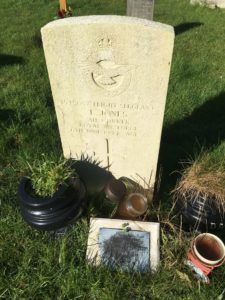
MKII V.1739 tractant le CN 45. A son bord F/O H. BULL, SGT BARRATT W., SGT HOWARD F.J., F/SGT JONES L., SGT HIBBERT J. A l'approche des côtes havraises, la défense anti-aérienne allemande, en état d'alerte, touche le bombardier et le planeur à deux reprises, le câble de remorquage casse, le planeur fut livré à son destin.
Mais un homme gît au sol dans l'Albemarle, le Flight Sergeant Leonard JONES est gravement blessé...
L'appareil de retour en Angleterre atterrit en catastrophe à Ford pour bénéficier d’une aide médicale mais le mitrailleur du V.1739 décède à l’hôpital de ses blessures, il avait 23 ans.

The tractor plane and its crew, the tragedy of the CN 45
The aircraft was an Albemarle MKII V.1739, departing from Brize Norton, with 8 aircraft taking off at the time to transport gliders. On board were F/O H. BULL, SGT BARRATT W., SGT HOWARD F.J., F/SGT JONES L., SGT HIBBERT J. As they approached the coast of Le Havre, the German anti-aircraft defence system, on high alert, hit the bomber and glider twice, the tow cable broke and the glider was doomed. But a man lay on the ground in the Albemarle, Flight Sergeant Leonard JONES, who was seriously injured...
On its return to England, the aircraft made an emergency landing at Ford in order to get medical assistance, but the gunner on V.1739 died in hospital from his wounds. He was 23 years old.
La propagande allemande
Le CN45 disparu, devint une aubaine pour les Allemands, loin des combats, il sert d’outil de communication, pour la propagande !
Un film est tourné où l’on voit les Allemands y extraire la jeep, pour annoncer l’échec du Débarquement. Mi-juin des tracts en allemand et en néerlandais sont édités pour duper les populations.

German propaganda
The CN45, which had disappeared for the Allies, became a godsend for the Germans: far from the fighting, it was used as a communications tool for propaganda !
A film was made showing the Germans extracting the jeep to announce the failure of the landings, and in mid-June leaflets in German and Dutch were published to fool the population.
Les recherches
C’est en 2021 que la localisation du crash du planeur est définitivement trouvée. En effet, des passionnés cherchent ce planeur depuis une vingtaine d’années, l’étude des images de l’Armée Allemande et les témoignages font penser au secteur de Bolbec, où se sont concentrées les recherches… Mais des mythes subsistent à Montivilliers, une trace dans un champ, sur une photo aérienne d’époque, permet de reprendre ces recherches dès 2017. Malgré des quiproquos avec un bombardier américain touché en août 1944 et des témoignages erronés, l’endroit est vérifié après une étude topographique et une analyse des différentes photos d’archives.
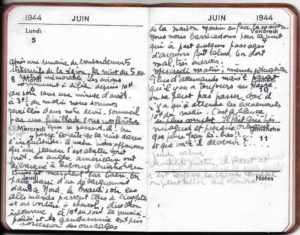
Finalement c’est une famille de Montivilliers qui transmet un agenda dans lequel Madame Jeanne Deveaux, assistant à la scène de sa fenêtre, relata le récit de ce fait marquant.
Research
It was in 2021 that the location of the glider crash was definitively found. Enthusiasts had been searching for the glider for some twenty years, and the study of German Army images and eyewitness accounts suggested the Bolbec sector, where the search was concentrated... But some myths still persisted in Montivilliers about the glider, and a trace in a field on a vintage aerial photograph led to the search being relaunched in 2017. Despite misunderstandings about an American bomber being hit in August 1944 and erroneous eyewitness accounts, the location was verified after a topographical study and an analysis of various archive photos.
Finally, a family from Montivilliers handed over a diary in which Madame Jeanne Deveaux witnessed the scene from her window and recounted her account of this significant event.
La robe de la petite Annie

Little Annie's dress
After the search by the Germans, the glider aroused the curiosity of the Montivillions, especially after the mass on Sunday 11 June 1944. Everyone wanted a piece of the glider... But Pierre André Deveaux, who lived nearby, had already recovered a priceless treasure for the time, a silk parachute! Gliders are indeed equipped with a parachute to assist braking. Jeanne Deveaux, Pierre's sister, made two bridesmaid dresses for Pierre's daughter Annie, her niece, for 2 family weddings in September 1945 and July 1946.
Ce panneau pédagogique est mis en page et offert par l’association Les Amis du Monts Canisy.
Textes et documents fournis par l'association POPPIES FOR TOMMIES
Commentaires